
Self-driving cars aren’t just an idea anymore. They’re already on the road.
The real question now is how quickly these vehicles will become commonplace around the world.
There are three main goals behind them: to make roads safer, to make driving more comfortable, and to save money for businesses and car owners.
We’ve compiled some surprising facts and statistics about self-driving cars you should know.
***
1. The global autonomous mobility industry’s total revenue is projected to reach roughly 4.5 trillion U.S. (by 2030) various degrees of vehicle automation. — Statista
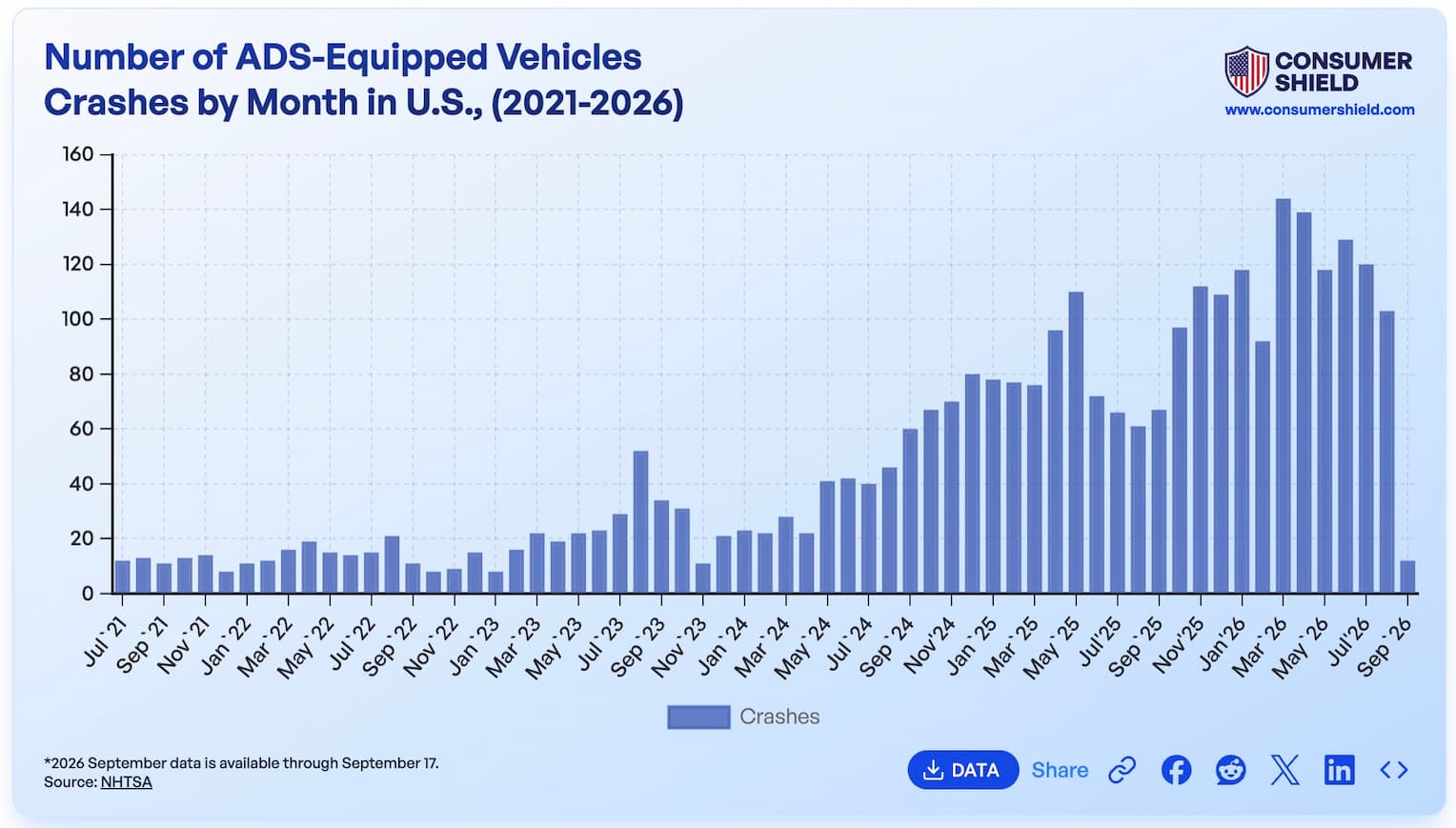
2. Self-driving cars have 9.1 crashes per million miles driven, while regular vehicles have 4.1 crashes per million miles. — ConsumerShiled
3. In 2026, there are over 10,000 SAE Level 4 robotaxi vehicles in 32 cities, while most new passenger cars have Level 2/2+ driver-assistance systems as standard. Automakers prioritize advanced hands-free assistance over Level 3. — DataM Intelligence
4. The Europe Autonomous Driverless Cars market size is estimated to reach $6.76 billion by 2025, and is projected to grow to $43.73 billion by 2031. — Market Research Reports
5. In 2026, SAE Level 2 (including advanced Level 2+ systems) is the most widely available autonomy level in consumer vehicles (e.g., Tesla FSD (Supervised), GM Super Cruise, Ford BlueCruise, and Rivian systems).
6. In the spring of 2026, Waymo surpassed the milestone of 500,000 fully autonomous paid rides per week. Sundar Pichai revealed this information during Alphabet’s Q1 conference call in late April. — The Motley Fool
7. On April 8, 2026, Verne launched what it calls Europe’s first commercial robotaxi service in Zagreb. Through its app, the public can book and pay for driverless rides. — TNW
8. As of September 30, 2026, Pony.ai’s robotaxi fleet had grown to 2,768 vehicles, and the company says it is on track to reach 3,500 by the end of the year. — Let’s Data Science
9. Through September 2025, Waymo’s driverless cars reported 94 crashes resulting in injury. In comparison, a human-driven benchmark had 501 crashes resulting in injury over the same miles and areas. — AI Adoption
10. The cost of an autonomous electric delivery truck is expected to be less than half of the cost in U.S. dollars per ton-mile of a human-driven diesel truck. — Statista
Tesla FSD Supervised logs 6 million miles between major collisions, about 9x the U.S. average, per Tesla’s new North America safety data.
12. France, Germany, Italy and 14 other countries signed a joint declaration to coordinate cross-border autonomous vehicle testing. — Euronews
13. Three groups were set to launch London trials in June 2026: Waymo, Wayve in partnership with Uber, and Baidu’s Apollo Go. — The Star
14. As of June 2026, Apollo Go’s fleets had accumulated over 350 million autonomous kilometers, including over 240 million fully driverless. Its footprint reached 28 cities. — Baidu Q2 2026 Report
By 2030, it is predicted that autonomous vehicles will account for 10% of the worldwide fleet of cars. — Hostinger
16. By 2028, Uber plans to have at least 10,000 fully driverless vehicles on the road. The company is expanding with about 10 autonomous-vehicle partners and aims to operate in nearly 20 cities next year. — Yahoo Finance
17. Bolt with Lucid, Mercedes-Benz, Volkswagen Commercial Vehicles and Einride are showcasing selected autonomous-mobility use cases on the NVIDIA Hyperion computing platform. — Nvidia
18. Chery is considering a future with fewer private car buyers, as the number of driverless fleets increases and analysts predict different outcomes for vehicle sales. — CarExpert
19. With about 4000 cars Waymo is the leader in the commercial autonomous vehicle market for full driverless operations. — New Market Pitch
20. There are 1.74 million active Tesla FSD (Supervised) subscriptions, which is up 67% from last year. FSD is also attached to over 75% of new North American deliveries. — Vested